


A fabric can stretch comfortably during movement and still look loose after it is released. That is why stretch and recovery belong in separate descriptions. Stretch concerns how far a material extends under stated conditions. Recovery concerns what happens when the force is removed, including how much extension remains after a defined interval.
For clothing, the distinction helps explain why two garments with similar give can behave differently at the knees, elbows or waistband. A fabric label and a quick tug offer useful impressions, but neither replaces a comparison with clear dimensions, conditions and timing.
Define the length before using a percentage
Percentage extension needs an original reference length. If a marked section begins at 100 millimetres and extends to 130 millimetres under a stated load, the added length is 30 millimetres. Dividing that change by the original 100 millimetres gives 30 per cent extension.
The number describes the particular conditions used. It should not be treated as a permanent property independent of force, direction, time or previous handling. A knitted fabric pulled across its width may behave differently from the same fabric pulled along its length.
When reading a specification, check what “stretch” means in that document. Does it name a test method, a direction and a defined loading condition? A percentage with no measurement description may be useful marketing shorthand, but it is not a complete technical comparison.
Use the correct method for the fabric type
Test methods have scopes. The official ASTM D2594/D2594M description concerns stretch properties of knitted fabrics with low power. The ASTM D3107 description concerns woven fabrics made from stretch yarns. Their existence illustrates why the fabric construction belongs in the test description.
The worked examples here are simple arithmetic exercises, not certified implementations of either standard. A formal result requires the appropriate complete method and equipment. Do not label a hand measurement “ASTM tested” merely because the same words appear in a spreadsheet.
For a buying or design discussion, ask whether the compared fabrics were evaluated with compatible methods. Results obtained under different forces or recovery intervals may not support a direct ranking, even when both are printed as percentages.
Compare equal stretch with different recovery
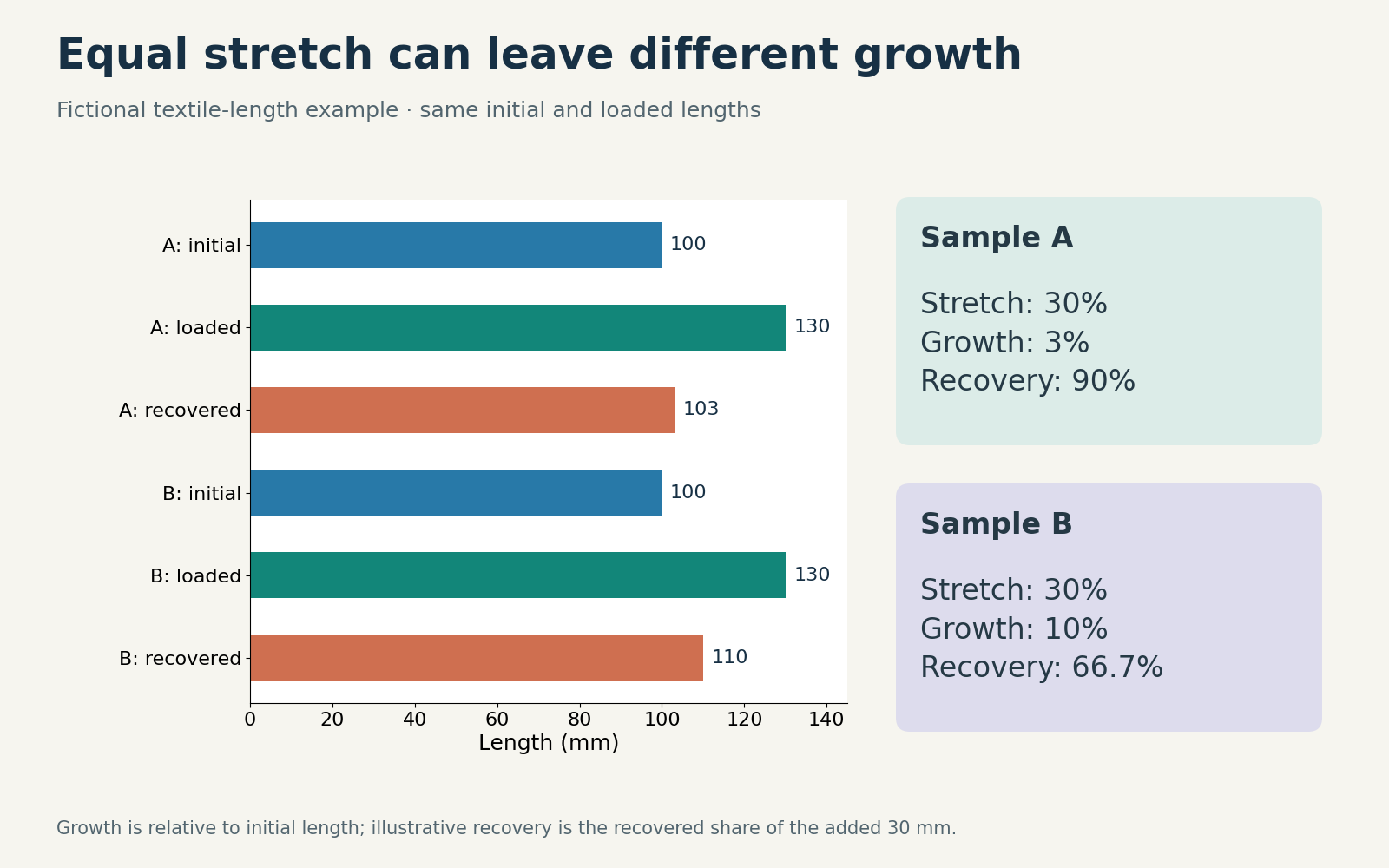
Consider two fictional specimens. Both start at 100 millimetres and reach 130 millimetres under the same imagined loading condition. After an equally defined rest interval, specimen A measures 103 millimetres and specimen B measures 110 millimetres. Both initially extended by 30 per cent, but they did not return equally close to their starting lengths.
| Measurement | Specimen A | Specimen B |
|---|---|---|
| Original length | 100 mm | 100 mm |
| Loaded length | 130 mm | 130 mm |
| Length after stated rest | 103 mm | 110 mm |
| Residual growth relative to original | 3% | 10% |
Using an illustrative recovery calculation, A recovered 27 of the added 30 millimetres, or 90 per cent of its extension. B recovered 20 of the added 30 millimetres, or approximately 66.7 per cent. These recovery percentages use the added extension as the denominator, while residual growth uses the original length.
That difference in denominators is easy to overlook. Three per cent residual growth does not mean 97 per cent recovery under this calculation. Always state the formula rather than assuming two percentages must sum to 100.
Time belongs in a recovery claim
“After release” is incomplete if the material continues changing during the observation interval. A measurement taken immediately and one taken later can differ. Specify the rest period when recording a result, and compare specimens at the same stated time.
A useful worksheet has separate fields for loaded duration and recovery duration. It also records whether the specimen had been stretched previously. Repeated handling may make a casual showroom comparison difficult to interpret because one sample has experienced a different history from another.
If you photograph the specimen, include a scale and keep the camera position consistent. Perspective can make two equal lengths appear different. The photograph should support the measurement record, not become an excuse to estimate millimetres from an uncalibrated image.
Use the same marked section for all three lengths in the arithmetic exercise. Measuring the full specimen initially and a shorter marked section afterward would change the reference without announcing it. Record the values before rounding, and retain the measurement resolution. If a ruler can only support a whole-millimetre reading, a spreadsheet displaying four decimal places should not be mistaken for four decimal places of measurement accuracy. The calculated percentage can be rounded to a level consistent with the observations.
A garment adds seams, fit and construction
A fabric result concerns the tested specimen. A finished garment adds seams, shaping, panels and the way forces are distributed during wear. A well-performing fabric can be used in a design that restricts movement, while a garment can feel forgiving because of its cut rather than a large measured stretch percentage.
Keep fabric and garment observations in separate columns. “The material returned close to its original marked length” and “the jacket allowed comfortable reaching” are both useful statements, but they describe different tests. One should not be presented as a substitute for the other.
For a practical comparison, choose the question first. Are you investigating bagging after repeated bending, comfort during movement or recovery after a single extension? The most informative observation depends on that question, so collecting one convenient number may leave the real issue unanswered.
Read stretch language with a measurement checklist
When a product description claims excellent recovery, look for the reference length, direction, loading conditions, rest interval and calculation. If some details are unavailable, record that limitation without inventing them. You can still describe the garment’s feel while keeping that observation separate from a formal performance claim.
The language also prepares a useful bridge into biology. Clothing fibres and biological elastic tissues can both be discussed using extension and recovery, but they are made from different materials and tested in different settings. The shared word “elastic” is a starting point for comparison, not proof of shared chemistry.
Understanding the measurement first makes the next distinction easier: elastane in a clothing label is not elastin in a tissue. Similar names can describe different substances, and a clear material identity matters as much as a clear percentage.